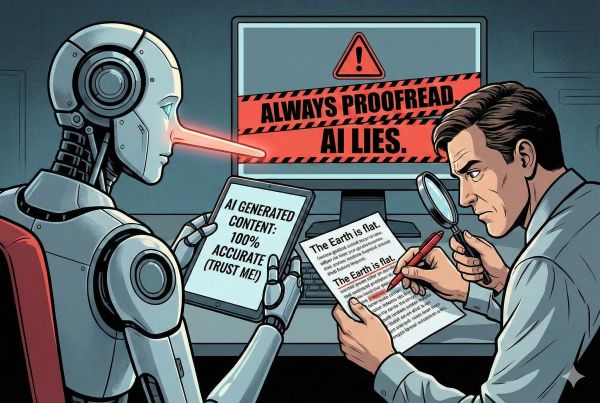
Your AI Content Is Going Out With Your Name On It. Are You Sure About That?
Let’s talk about something uncomfortable.
You're using AI to write your content.
Which is smart.
But you're not reading it before it goes out.
Which is not smart.
And your audience is noticing.
Not always out loud.
But they’re noticing.
The Credibility Problem
Here’s what happens when you let AI write something and send it without reviewing it:
Your email goes out to your entire list addressed to "Hey [FIRST NAME]."
Your blog post uses words you've told your brand to never use.
Your social media caption references something completely irrelevant to your business.
Your newsletter calls you by a different name.
Your "personal" story sounds like it was written about a stranger.
Every one of those mistakes tells your audience the same thing:
You didn’t care enough to read what you put your name on.
And if you don’t care enough to read it, why should they care enough to trust it?
The Trust Factor
As coaches and consultants, your entire business is built on trust.
People hire you because they believe you know what you're doing.
They follow you because they think you're paying attention.
They buy from you because they trust your judgment.
Every sloppy AI mistake that goes out publicly chips away at that trust.
One "Hey [FIRST NAME]" email won't destroy you.
But a pattern of careless, generic, obviously unreviewed content?
That absolutely will.
The "I Can Always Tell" Problem
Here’s a truth that’s hard to hear:
Your audience can tell when you didn’t write something.
Not always.
But often enough that it matters.
The tell isn’t that it was AI-assisted.
The tell is that it doesn’t sound like you.
The words are slightly off.
The examples are generic.
The sarcasm is missing.
The personal stories aren’t there.
The perspective that makes your content uniquely yours is gone.
And your audience—the people who follow you specifically because of YOU—feels it.
They might not know why the content feels different.
But they feel the distance.
And distance is the opposite of connection.
And connection is what builds clients.
What Reviewing Your AI Content Actually Looks Like
Reviewing your AI output isn’t reading it once at the speed of light and calling it done.
It’s asking specific questions as you read:
Does this sound like me?
Would I actually say this sentence out loud?
Are there any placeholder brackets that didn’t get filled in?
Is the tone consistent with my brand?
Did it use any words I specifically don’t use?
Are the examples relevant to my actual audience?
Does this make sense to someone who doesn’t know the AI context I gave it?
Is there anything in here that feels generic, vague, or like it could belong to anyone?
That review takes five minutes on a short piece.
Maybe fifteen on a longer one.
But it’s the difference between content that builds your brand and content that quietly erodes it.
The AI Is Not Trying to Embarrass You
Here’s something important to understand about AI mistakes:
They’re not personal.
AI isn’t cutting corners.
It’s not being lazy.
It completed the task you gave it.
The mistake is almost always in the brief—you didn’t give it enough context.
Or in the review—you didn’t catch what it got wrong.
The AI’s job is to generate.
Your job is to approve.
When you skip the approval step, you’re the one who made the mistake.
Not the AI.
This is actually good news.
Because it means you have complete control over the quality of what goes out.
You just have to use it.
The Standard We’re Holding Ourselves To
We use AI to help create content.
A lot of it.
But every single piece gets read, edited, and approved before it goes anywhere.
Not because we don’t trust the AI.
Because we respect our audience enough to make sure what reaches them actually represents us.
That’s the standard.
And it’s not a high bar.
It’s just the bar that keeps your credibility intact.
Action Steps:
Create a simple pre-publish checklist for all AI-assisted content.
Before anything goes out, run through: Does it sound like me? Any unfilled placeholders? On-brand language? Relevant examples?
Build the review into your workflow—not as an afterthought, but as a required step.
If you’re delegating AI content to a team member, build the same review process into their checklist.
Train your AI better so there’s less to fix in the review.
Start here:
go.myclonesolutions.com/aipersonaworkshop